# 10 Practical Agenda Outline for Meetings Templates for 2025
Poorly run meetings drain time, energy, and morale. The solution isn't another lecture on why agendas are important; it's having the right structure for the specific conversation you need to have. This article provides that structure.
You'll find 10 distinct agenda outlines for meetings, each for a different purpose, from a high-stakes board of directors session to a routine one-on-one. Each template includes suggested timings, roles, and sample phrasing you can adapt. I've also included quick customization tips for remote and hybrid environments.
A good agenda sets the stage for a productive discussion, but a meeting's value is measured by its outcomes. To ensure your meetings are productive, a well-structured agenda must be paired with effective documentation. If you're tired of meetings that go nowhere, explore this Practical Guide to Meeting Minutes with Action Items (opens new window) on creating an actionable record. This guide will help you build a system where decisions lead to action. Use these agenda outlines to make your meetings focused, efficient, and conclusive.
# 1. Executive Leadership Meeting Agenda
An Executive Leadership Meeting agenda is a decision-oriented framework for C-suite and senior management. Unlike operational check-ins, this format strictly focuses on strategic choices, company performance metrics, and major initiatives that require top-level approval. The goal is efficiency and impact, with a typical duration of 60–90 minutes. Leadership at companies like Apple and Amazon use versions of this structure.
The key to this agenda's success is pre-work. All reports, data, and background materials are distributed at least 48 hours in advance, with the expectation that everyone arrives prepared to discuss and decide, not to be briefed. This approach, used by figures like Jeff Bezos, transforms the meeting from a presentation into a strategic work session. If a topic is purely informational or can be resolved by a smaller group, it doesn't make the cut.
# Sample Agenda Structure (90 Minutes)
- Review of Key Metrics (15 min): Quickly review the top 3-5 company KPIs. The owner of each metric speaks only to variances or critical trends.
- Strategic Decision #1 (25 min): Deep dive into the first major agenda item requiring a decision.
- Strategic Decision #2 (25 min): Address the second key decision point.
- Action Items & Accountability (10 min): Clearly assign owners and deadlines for all decisions made.
- Parking Lot Review (5 min): Briefly address any deferred topics to determine next steps.
# When to Use This Agenda Outline for Meetings
Use this agenda when decisions carry significant financial or strategic weight and require input from multiple senior leaders. It's for quarterly strategy reviews, major investment approvals, or addressing significant market shifts.
# 2. Project Status Update Meeting Agenda
A Project Status Update Meeting agenda provides a recurring, tactical framework for teams to track progress, identify roadblocks, and maintain stakeholder alignment. This meeting, often held weekly or bi-weekly, is the pulse of a project, focusing on deliverables, timelines, and immediate next steps. Its structured nature is a feature of Agile methodologies and is used in sprint reviews at Google and project governance at firms like Accenture.
The primary goal is communication and course correction, not deep problem-solving. Each participant comes prepared to give a concise update on their work, specifically noting what is complete, what is next, and what is blocked. This format prevents small issues from escalating into major delays by bringing them to the group's attention. Any complex blocker that requires a longer discussion is immediately scheduled for a separate, smaller meeting.
# Sample Agenda Structure (45 Minutes)
- Project Health & KPIs Review (5 min): The project manager provides a quick overview of the budget, timeline, and key milestones.
- Individual Progress Updates (20 min): Each team member shares a 2-3 minute update: what I accomplished, what I’m doing next, and any blockers.
- Blocker Triage & Resolution (15 min): The team collectively addresses any identified blockers. The focus is on assigning owners to solve the problems, not solving them in the meeting.
- Action Items & Next Steps (5 min): A dedicated note-taker recaps all action items, owners, and deadlines to ensure clarity.
# When to Use This Agenda Outline for Meetings
Use this agenda for any project with multiple moving parts and interdependencies that requires regular check-ins to stay on track. It is useful for software development sprints, marketing campaigns, and event planning.
# 3. Sales Team Meeting Agenda
A Sales Team Meeting agenda is a framework designed to review performance, strategize on active deals, and maintain team momentum. This format moves beyond simple pipeline updates to include coaching, skill-sharing, and celebrating wins. The goal is to create a focused session that directly contributes to revenue goals, typically lasting 45–60 minutes. Methodologies from Salesforce and Sandler Sales Training have influenced this balanced approach.
The effectiveness of this agenda depends on data-driven discussions. Visual dashboards showing key sales metrics should be prepared beforehand, allowing the team to instantly identify trends and focus on deals that need collective problem-solving. Around 60% of the meeting should be dedicated to strategizing on these opportunities, turning the sync into a coaching session rather than a status report.
# Sample Agenda Structure (60 Minutes)
- Wins & Recognition (5 min): Start on a high note by celebrating recent successes and acknowledging top performers.
- Key Metrics Review (10 min): Briefly review a sales dashboard covering pipeline health, conversion rates, and activity goals. Discuss only significant changes.
- Deal Strategy & Obstacle Removal (30 min): Focus on 2-3 specific deals where team input can help overcome challenges or accelerate closure.
- Skill Share & Best Practices (10 min): A team member shares a recent technique or insight that worked well.
- Action Items & Commitments (5 min): Confirm next steps for key deals and assign owners.
# When to Use This Agenda Outline for Meetings
Use this agenda for weekly or bi-weekly sales team syncs to maintain focus and motivation. It is also effective for monthly performance reviews where both metrics and strategy are discussed. To streamline your sales team's discussions, you might find these essential sales meeting templates (opens new window) useful. This structure ensures every meeting is an actionable work session that builds both skills and pipeline.
# 4. Board of Directors Meeting Agenda
A Board of Directors Meeting agenda is a formal framework for governance, compliance, and long-term strategic oversight. Unlike an executive meeting, this agenda operates under strict legal and procedural requirements dictated by corporate governance standards. Held quarterly or bi-annually, its purpose is to ensure the company remains aligned with shareholder interests, regulatory obligations, and its strategic mission. Companies like JPMorgan Chase and Disney use this format to manage their complex governance structures.
The effectiveness of this agenda relies on meticulous preparation and adherence to formal processes. Board packages, containing detailed reports and financial statements, are distributed a week in advance. The meeting itself is for discussion, challenge, and formal decision-making. Following guidelines from bodies like the National Association of Corporate Directors (NACD), the structure ensures that every item requiring board action is properly documented and every vote is recorded in detailed minutes for legal protection.
# Sample Agenda Structure (3-4 Hours)
- Call to Order & Approval of Minutes (15 min): Formal opening and approval of the previous meeting’s minutes.
- Consent Agenda (10 min): A single vote to approve a block of routine, non-controversial items.
- CEO & Management Reports (60 min): Presentation and discussion of company performance and strategic initiatives.
- Committee Reports (45 min): Updates from key committees (e.g., Audit, Compensation, Governance).
- Strategic Discussion/Action Items (60 min): Deep dive into specific matters requiring board deliberation and a vote.
- Executive Session (30 min): A confidential session for independent directors without management present.
# When to Use This Agenda Outline for Meetings
This formal agenda outline for meetings is mandatory for scheduled board meetings of any corporation. It is for fulfilling legal duties, making major financial or strategic decisions (like M&A activity), and ensuring proper corporate governance. It is not suitable for operational or day-to-day business discussions.
# 5. One-on-One Meeting Agenda
A One-on-One Meeting agenda creates a dedicated space for managers and their direct reports to connect personally and professionally. This format is designed to build trust, support career development, and proactively address roadblocks. Its power lies in its consistency and focus on the employee's perspective, making it a foundation of management philosophies at companies like Google and advocated by leaders such as Kim Scott, author of Radical Candor.
This agenda outline for meetings succeeds by shifting ownership. The employee is encouraged to contribute at least half of the talking points, ensuring their concerns and growth opportunities are addressed. The manager’s role is to listen, ask clarifying questions, and serve as a coach rather than a taskmaster. This dynamic transforms the meeting from a top-down review into a collaborative partnership focused on long-term success.
# Sample Agenda Structure (30-45 Minutes)
- Employee-Led Topics (15 min): The employee shares their updates, challenges, and questions. This is their time to drive the conversation.
- Manager-Led Topics (10 min): The manager provides feedback, shares relevant company updates, and discusses performance from a coaching perspective.
- Growth & Development (10 min): Focus on career aspirations, skill-building, and long-term goals. This section ensures the conversation goes beyond immediate tasks.
- Action Items & Follow-Up (5 min): Both parties agree on clear next steps, which are documented and reviewed in the next meeting.
# When to Use This Agenda Outline for Meetings
Use this agenda for regularly scheduled (weekly or bi-weekly) check-ins between a manager and a direct report. It is good for building strong working relationships, maintaining employee engagement, and identifying potential issues before they escalate. It is less effective for urgent project-specific problem-solving, which should be handled in a separate, dedicated meeting.
# 6. Client/Customer Meeting Agenda
A Client/Customer Meeting agenda is designed to build relationships and achieve business objectives simultaneously. It shifts the focus from an internal monologue to a collaborative dialogue, prioritizing the client's needs, goals, and pain points. This format is less about presenting and more about listening, diagnosing, and co-creating solutions. It's a key part of consultative frameworks used by firms like McKinsey and enterprise software teams at Salesforce, where understanding the customer is essential to success.
The effectiveness of this agenda outline for meetings depends on pre-meeting research. The host must understand the client's business, industry, and the specific challenges they face. This preparation allows the meeting to move beyond generic pitches into a tailored, value-driven conversation. Instead of a rigid script, the agenda acts as a flexible guide to ensure all key discovery questions are answered and next steps are clearly defined.
# Sample Agenda Structure (60 Minutes)
- Rapport & Objective Alignment (10 min): Start with brief introductions and confirm the meeting’s primary goal from the client’s perspective.
- Discovery & Needs Analysis (25 min): Use open-ended questions to explore the client’s challenges, priorities, and desired outcomes.
- Solution Brainstorming/Presentation (15 min): Present a tailored overview of how your solution addresses their specific needs, focusing on value, not features.
- Next Steps & Mutual Commitment (10 min): Define clear, actionable next steps. Schedule a follow-up meeting before the current one ends.
# When to Use This Agenda Outline for Meetings
Use this agenda for any external-facing interaction where customer success is the goal. It is perfect for sales discovery calls, project kick-offs with new clients, quarterly business reviews, and financial advisory sessions. The structure ensures the client feels heard, which is needed for building long-term partnerships.
# 7. Brainstorming and Innovation Meeting Agenda
A Brainstorming and Innovation Meeting agenda is a creative, flexible framework designed to generate a high volume of ideas and solve complex problems. Unlike decision-driven meetings, this format intentionally minimizes rigid structure to maximize creative thinking. The primary goal is idea generation, not immediate evaluation, making it ideal for kickstarting new product concepts, marketing campaigns, or process improvements. This approach is used in different forms by organizations like IDEO and Google.
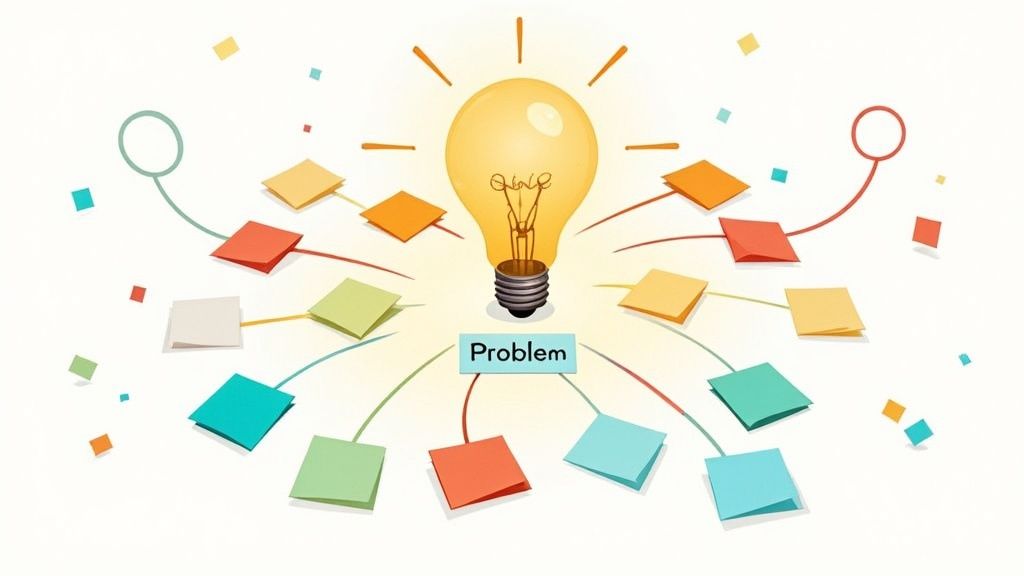
The success of a brainstorming session depends on establishing psychological safety and a clear problem statement beforehand. All participants must understand the core challenge and agree to the "no criticism" rule, where every idea is captured without judgment. This principle, popularized by creative thinking pioneers like Alex Osborn, ensures that even seemingly impractical suggestions are welcomed, as they can spark more viable concepts. Facilitators often use visual tools like digital whiteboards or physical sticky notes to keep ideas flowing.
# Sample Agenda Structure (60 Minutes)
- Problem Statement & Rules of Engagement (5 min): The facilitator clearly defines the problem to be solved and outlines the ground rules, such as "quantity over quality" and "defer judgment."
- Warm-up Creative Exercise (5 min): A quick, unrelated creative task to get participants into an innovative mindset.
- Silent Idea Generation (10 min): Individuals write down as many ideas as possible on their own without discussion.
- Round-Robin Idea Sharing (25 min): Each person shares one idea at a time, which is captured on a central board. This continues until all ideas are shared.
- Clarification & Grouping (10 min): The group quickly asks clarifying questions (not critiques) and begins to cluster similar ideas into themes.
- Wrap-up & Next Steps (5 min): The facilitator thanks everyone and explains how the ideas will be evaluated later.
# When to Use This Agenda Outline for Meetings
Use this agenda when you need to break through conventional thinking, explore a wide range of possibilities, or solve a problem that has no obvious solution. It is perfect for early-stage project planning, brand naming sessions, or finding new approaches to a persistent operational bottleneck.
# 8. All-Hands or Town Hall Meeting Agenda
An All-Hands or Town Hall Meeting agenda provides a blueprint for company-wide gatherings designed to align the entire organization. This format moves beyond departmental updates to focus on big-picture strategy, cultural reinforcement, and direct communication between leadership and employees. The goal is to foster transparency and a shared sense of purpose, typically in a 60-minute quarterly or semi-annual session. Companies like Microsoft and Slack use these meetings to maintain alignment across global teams.
A successful all-hands meeting balances information delivery with employee engagement. The agenda must be structured to prevent it from becoming a one-way lecture. This is achieved by intentionally building in interactive segments like live Q&A sessions, polls, and employee recognition spots. A well-crafted agenda ensures that employees leave feeling informed, valued, and connected to the company's mission.
# Sample Agenda Structure (60 Minutes)
- Welcome & Mission Moment (5 min): A senior leader opens the meeting, reinforcing company values or sharing a customer success story.
- Business Performance & Key Updates (20 min): Concise presentations from different department heads on major wins, progress against goals, and upcoming initiatives.
- Employee Spotlight or Team Showcase (10 min): Highlight an individual's or team's contribution, putting a human face on company success.
- Live Q&A Session (20 min): An open forum where employees can ask unfiltered questions to the leadership panel.
- Closing Remarks & Look Ahead (5 min): A final, forward-looking message to energize the team for the upcoming period.
# When to Use This Agenda Outline for Meetings
Use this agenda for major company-wide announcements, quarterly business reviews, or cultural reset initiatives. It helps build trust and ensures every employee receives the same core messages directly from leadership.
# 9. Cross-Functional or Departmental Collaboration Meeting Agenda
A Cross-Functional Collaboration Meeting agenda is a framework built to break down silos and unite different departments toward a shared objective. Its purpose is to manage dependencies, align on priorities, and ensure that teams like engineering, marketing, and sales are moving in lockstep. This format is for complex projects, such as product launches or digital transformation initiatives, where miscommunication can lead to delays and budget overruns.
This meeting’s success depends on clear accountability and a structured approach to dependency management. Frameworks like SAFe (Scaled Agile Framework) and methods from the Project Management Institute (PMI) influence this agenda. The goal is to produce an integrated plan. A neutral facilitator is often useful, ensuring no single department's priorities dominate the conversation.
# Sample Agenda Structure (60 Minutes)
- Shared Goal & Status Review (10 min): The facilitator restates the overall project objective. Each department lead gives a 2-minute update focused on progress and blockers.
- Dependency Mapping & Risk Assessment (20 min): Visually review a dependency map (prepared beforehand). The group identifies and discusses critical path items and potential risks.
- Cross-Functional Problem Solving (15 min): Address the top 1-2 blockers or risks identified. This is a working session to find solutions, not just report problems.
- Action Items & Accountability (10 min): Using a RACI (Responsible, Accountable, Consulted, Informed) model, assign ownership for each action item. All commitments are documented in a shared tool like Asana or Jira.
- Communication & Next Steps (5 min): Confirm the plan for communicating decisions to respective teams and set the date for the next check-in.
# When to Use This Agenda Outline for Meetings
Use this agenda outline for meetings where success requires tight coordination between two or more distinct teams. It's ideal for project kick-offs, quarterly program increment (PI) planning sessions, or milestone reviews. Avoid this format for routine departmental updates; it is specifically for integrated planning and problem-solving sessions.
# 10. Performance Review and Feedback Meeting Agenda
A Performance Review and Feedback Meeting agenda provides a formal, documented structure for one-on-one conversations about an employee's contributions, challenges, and growth. This framework is designed to move beyond a one-sided assessment, creating a two-way dialogue that is fair, evidence-based, and forward-looking. Its goal is to align individual performance with company objectives while building a clear path for professional development.
This structured approach is part of modern HR practices, influenced by a shift toward continuous feedback seen at companies like Adobe and Netflix. The key is preparation from both the manager and the employee. Sharing a self-assessment beforehand and providing specific, behavior-based examples prevents surprises and focuses the conversation on concrete actions rather than abstract judgments. This agenda transforms a potentially tense meeting into a productive development session.
# Sample Agenda Structure (60 Minutes)
- Opening & Agenda Review (5 min): Set a positive tone and briefly outline the meeting's purpose and structure.
- Employee Self-Assessment Review (15 min): The employee shares their perspective on their performance, accomplishments, and challenges first.
- Manager's Feedback & Assessment (20 min): The manager provides their evaluation, supported by specific examples and data. Discuss areas of strength and opportunities for improvement.
- Goal Setting & Development Plan (15 min): Collaboratively set 2-3 specific, measurable goals for the next review period and identify necessary resources or support.
- Wrap-up & Next Steps (5 min): Summarize key takeaways, confirm mutual understanding of the development plan, and schedule the next check-in.
# When to Use This Agenda Outline for Meetings
Use this agenda for official semi-annual or annual performance reviews that require formal documentation for HR records. It's also effective for structured quarterly check-ins focused on progress against goals. Avoid this formal structure for routine, informal feedback, which should be given in real-time.
# Comparison of 10 Meeting Agenda Outlines
| Agenda | Implementation complexity 🔄 | Resource requirements ⚡ | Expected outcomes 📊 | Ideal use cases 💡 | Key advantages ⭐ | Key tips 💡 |
|---|---|---|---|---|---|---|
| Executive Leadership Meeting Agenda | 🔄 High — formal structure; strict timing and prep | ⚡ Moderate — executive time, concise analytics & summary handouts | 📊 Strategic decisions, alignment, clear accountability | 💡 C-suite strategy reviews and high‑stakes decisions | ⭐ Focused decision-making; clear ownership | 💡 Pre-circulate 48h; limit to 5–7 items |
| Project Status Update Meeting Agenda | 🔄 Low–Medium — repeatable cadence and template | ⚡ Low — PM time, project data, note-taker | 📊 Progress visibility; early blocker escalation | 💡 Weekly/bi-weekly project tracking and sprints | ⭐ Maintains momentum; documents history | 💡 Keep updates 2–3 min/person; highlight blockers first |
| Sales Team Meeting Agenda | 🔄 Medium — blends metrics, coaching, and pipeline review | ⚡ Moderate — dashboards, sales data, facilitator | 📊 Pipeline clarity; deal prioritization; motivation | 💡 Weekly sales syncs, monthly reviews, QBRs | ⭐ Drives performance and recognition | 💡 Use visual dashboards; reserve time for key deals and wins |
| Board of Directors Meeting Agenda | 🔄 Very High — formal governance, legal and procedural rules | ⚡ High — extensive board packs, legal counsel, prep time | 📊 Compliance, governance oversight, material decisions | 💡 Quarterly board governance and fiduciary approvals | ⭐ Ensures regulatory compliance and documented decisions | 💡 Distribute packages 5–7 days ahead; use consent agendas |
| One-on-One Meeting Agenda | 🔄 Low — flexible, conversational structure | ⚡ Low — manager time, private notes | 📊 Improved engagement, development, early issue detection | 💡 Manager–direct report development and feedback | ⭐ Strengthens relationships and retention | 💡 Let employee lead half; listen 70/30; schedule consistently |
| Client/Customer Meeting Agenda | 🔄 Medium — tailored per client, adaptive flow | ⚡ Moderate — prep, SMEs, customized materials | 📊 Aligned solutions; clear next steps; stronger relationships | 💡 Sales pitches, consultative sessions, implementation planning | ⭐ Builds trust and customer-centric alignment | 💡 Research client; bring decision-makers; follow up within 24h |
| Brainstorming and Innovation Meeting Agenda | 🔄 Low–Medium — loose structure but needs facilitation | ⚡ Low — diverse participants, visual tools, facilitator | 📊 High idea volume; creative solutions; culture uplift | 💡 Product ideation, campaign concepts, problem-solving workshops | ⭐ Generates diverse ideas rapidly | 💡 Set "no criticism" rule; capture all ideas; evaluate later |
| All-Hands or Town Hall Meeting Agenda | 🔄 Medium — large-scale coordination and pacing | ⚡ High — AV, leadership time, polished content | 📊 Company alignment, transparency, morale boost | 💡 Company-wide updates, announcements, recognition | ⭐ Scales messaging and builds engagement | 💡 Keep concise; use polls/Q&A; record and follow up |
| Cross-Functional Collaboration Agenda | 🔄 Medium — coordinates many stakeholders and dependencies | ⚡ Moderate — facilitators, dependency maps, shared tools | 📊 Reduced silos; synchronized timelines; clearer handoffs | 💡 Product launches, integrated programs, PI planning | ⭐ Improves delivery speed and cross-team transparency | 💡 Use RACI and visual dependency maps; assign neutral facilitator |
| Performance Review & Feedback Agenda | 🔄 Medium — structured, evidence‑based conversation | ⚡ Moderate — preparation, documentation, dedicated time | 📊 Documented performance, development plans, compensation outcomes | 💡 Annual/semi‑annual reviews and formal feedback cycles | ⭐ Creates clear expectations and development pathways | 💡 Prepare examples; share self-assessment first; allow 60–90 min |
# Make the Agenda Work for You
The outlines in this article are frameworks for reclaiming your time and ensuring every meeting has a clear purpose. A well-constructed agenda is your primary defense against unproductive gatherings. It transforms a meeting from a passive update into an active, decision-making event.
The real test of any agenda outline for meetings is its outcome. Did you leave with a clear decision? Was a problem solved? Do all participants know their exact next steps? If the answer is no, the agenda failed. The goal is to move beyond simply listing topics and instead architect a conversation that drives action. This involves assigning time blocks, defining roles, and phrasing agenda items as questions to be answered, not just subjects to be discussed.
# Adapting Agendas to Your Reality
True mastery comes from adapting these structures to your team's unique rhythm. A brainstorming agenda for a design team will look different from one for an engineering team. A client-facing meeting requires a different tone and structure than an internal project status update.
Consider these steps to begin:
- Pick one recurring meeting to overhaul. Start small. Choose a weekly team sync or project check-in that feels inefficient.
- Apply a relevant outline from this guide. Modify the timings and items to fit your specific goals for that meeting.
- Share the new agenda at least 24 hours in advance. State the desired outcomes for each item.
- Gather feedback after the meeting. Ask your team directly: "Was this more effective than our old format? What could we improve for next time?"
This iterative process of application and refinement is what turns a good agenda into a great one. The benefit is not just more efficient meetings, but a more focused, respectful, and productive work culture. When people know their time is valued, their engagement increases.
# Streamlining Your Focus in Remote Meetings
In remote settings, an agenda's effectiveness is tied to your control over the virtual environment. Fumbling for the mute button or struggling to share the right screen creates friction that derails the conversation. This is where you can gain an advantage by optimizing your meeting controls.
A dedicated utility like MuteDeck provides a universal control panel for your most-used functions: mute, camera, push-to-talk, and screen sharing. It works consistently across Zoom, Microsoft Teams, Google Meet, and other platforms. This eliminates the platform-specific muscle memory tax, freeing up your cognitive load to focus on leading the discussion, listening to your team, and driving the agenda forward. A solid agenda sets the strategy for the meeting; streamlined tools ensure you can execute it.
Ready to eliminate the friction of managing your virtual meetings? Take control of your mic, camera, and sharing with MuteDeck. See how a simple, universal control system can help you stay focused on your agenda, not your software. Learn more at MuteDeck (opens new window).