# Mastering the Board Meeting Agenda
A modern board meeting agenda should be your strategic compass, not just a to-do list for checking off boxes. It’s built to guide conversations toward future growth and the big decisions, pushing routine updates into pre-reading materials where they belong. A well-crafted agenda can single-handedly turn a passive reporting session into a powerhouse of collaboration.
# What a Modern Board Meeting Agenda Looks Like
Let’s be honest, for too long, the board meeting agenda has been a dumping ground for departmental reports and operational rundowns. It’s an old-school approach that leaves directors just sitting there, passively listening instead of rolling up their sleeves and lending their strategic expertise.
The modern way flips this completely. It runs on one powerful principle: board time is the company's most valuable and expensive resource. Every single minute should be spent on high-impact discussions that simply can’t happen anywhere else.
# Shifting from Reporting to Strategizing
The real split between a traditional and a strategic agenda comes down to focus. A traditional agenda is backward-looking, obsessed with reviewing what already happened. A strategic agenda, on the other hand, is forward-looking. It dedicates the bulk of its time to debating future opportunities, risks, and critical choices.
This doesn't mean you ignore performance data. Not at all. It just means that data is sent out and absorbed before the meeting. The agenda then frames topics as strategic questions, not as reports.
- Traditional: "Review of Q3 Financial Results"
- Strategic: "Discussion on Capital Allocation Priorities for Q4 Based on Q3 Performance"
That simple tweak in wording completely changes the game. You move the conversation from a stale report-out to a high-level strategic debate, making far better use of every director's time and talent.
A good way to think about it is comparing the old-school operational focus with the modern strategic approach.
# Traditional vs Strategic Board Meeting Agendas
| Characteristic | Traditional Agenda | Strategic Agenda |
|---|---|---|
| Focus | Backward-looking (reporting on past events) | Forward-looking (planning for the future) |
| Director Role | Passive listener, recipient of information | Active participant, strategic contributor |
| Primary Goal | Information sharing and operational review | Decision-making and strategic alignment |
| Content | Departmental reports, metrics, updates | Strategic questions, key decisions, risk analysis |
| Preparation | Minimal pre-reading, information presented live | Extensive pre-reading, data absorbed beforehand |
| Outcome | Awareness of past performance | Actionable plans for future growth |
As you can see, the shift is all about moving from a passive review to an active, forward-thinking work session.
Practical Tip: To ensure your agenda sparks real dialogue, apply the "email test." If an agenda item's objective can be fully achieved through an email update or a pre-read document, it doesn't belong on the main agenda. Reserve that valuable time for topics requiring live debate and collective wisdom.
# The Challenge of Limited Time
This strategic focus is more critical than ever, especially with schedules getting tighter and tighter. Today's board meetings are packed, leaving little room for deep dives. Research shows the average board meeting for a large company now lasts about 3 hours and 48 minutes and has to get through 11 different agenda items.
Do the math—that’s just 21 minutes per item, which is nowhere near enough time to properly tackle complex topics. If you want to dig deeper into these time constraints, you can explore the full state of board effectiveness in 2025.
This reality makes a strategic agenda non-negotiable. By cutting out the low-value “update” items, you reclaim precious minutes for the conversations that truly matter. A modern board meeting agenda is your best tool for ensuring that limited time is spent driving the organization forward, not just recounting its journey. It sets the tone for a proactive, engaged, and truly effective board culture.
# Building Your Agenda for Maximum Impact
A killer board meeting agenda doesn't just happen. It's built. Think of it less like a to-do list and more like a strategic script, carefully designed to cut through the operational chatter and lock everyone’s focus on the big picture.
The process starts with casting a wide net for topics. This can’t be a one-person show. A week or two before the meeting, the CEO and Board Chair should be reaching out to every director and key executive. A simple question works wonders: "What's the single biggest opportunity or threat we need to tackle in our next meeting?"
This simple act of inclusion gets buy-in before anyone even enters the room. It ensures the agenda reflects the collective brainpower of your leadership, not just what one or two people think is important.
# Sorting Topics for Strategic Clarity
Once you have a list of potential items, the real work begins. You need to sort every single topic to dictate how it gets handled. This is what separates a long list of updates from a true tool for action.
Every proposed item should fall into one of three buckets:
- For Information: These are your updates, reports, and metrics that don't need a live debate. Think of the final sales report for a quarter that hit its targets—essential context, but perfect for the pre-read board pack.
- For Discussion: These are the chewy, forward-looking topics where you need the board's collective wisdom. You might not need a decision right now, but you need open debate and strategic alignment. A great example: "Should we explore market entry into Southeast Asia?"
- For Decision: These items demand a formal vote. They need a crystal-clear proposal, all the supporting data, and a specific question for the board to answer. "Approve the Q3 capital expenditure budget" is a classic decision item.
This sorting method is the secret to a focused and high-impact board meeting agenda. It forces you to be intentional with every precious minute. To keep the board engaged, you’ll also want to make sure you’re including the right key meeting agenda topics (opens new window) that spark real strategic conversation.
# The Power of the Consent Agenda
One of the most powerful tools for clawing back time is the consent agenda. This is where you bundle all the routine, non-controversial items—like approving last month's minutes or accepting a standard committee report—and pass them with a single vote, no discussion needed.
Done right, a consent agenda can easily free up 30 to 60 minutes. That's time you can now pour into the substantive discussions and decisions that actually move the needle.
Practical Tip: To introduce a consent agenda, the chair should state, "You have received the consent agenda items in your board packet. Does any member wish to move an item from the consent agenda to the main agenda for discussion?" This gives directors a chance to flag anything they feel needs a closer look, ensuring transparency while maintaining efficiency.
# Allocating Time and Filtering Noise
With your topics sorted, it’s time to assign realistic time blocks. Don't fall into the trap of cramming too much in. A 15-minute slot is almost never enough for a meaningful strategic debate. Be generous with time, especially for high-stakes decisions.
Here’s a real-world example: A CEO wanted to add a 20-minute "IT Infrastructure Update" to the agenda. The Board Chair pushed back, asking, "Is there a strategic decision we need to make here, or is this just an update?" The item was moved to the pre-read materials, which freed up that time to dig into a more urgent cybersecurity risk assessment.
This is the kind of filtering that separates great boards from good ones. The board’s attention has to be on what matters most. A recent global survey found that boards want to spend more time on innovation, cybersecurity, talent, and climate change. But priorities shift depending on where you are—68% of US directors flagged political risk as a top-three concern, while in Brazil, it was all about the supply chain.
This data underscores why it's so critical to filter out the operational noise. You can see more insights on board priorities from the EY survey here. Your agenda needs to reflect the major strategic challenges of today, not just the updates from yesterday.
# Actionable Templates for Any Board Meeting
A generic, one-size-fits-all agenda just won't cut it for a board meeting. The intense focus of a crisis session is a world apart from the blue-sky thinking needed for an annual strategy offsite. If you want the right outcomes, you have to tailor the agenda to the meeting's purpose.
To make that process easier, I've put together a few adaptable templates for three common—and very different—types of board meetings. Think of them less as rigid outlines and more as strategic roadmaps designed to steer the conversation exactly where it needs to go.
This infographic breaks down the core pieces of a modern agenda, showing how to group items to keep everything clear and purposeful.
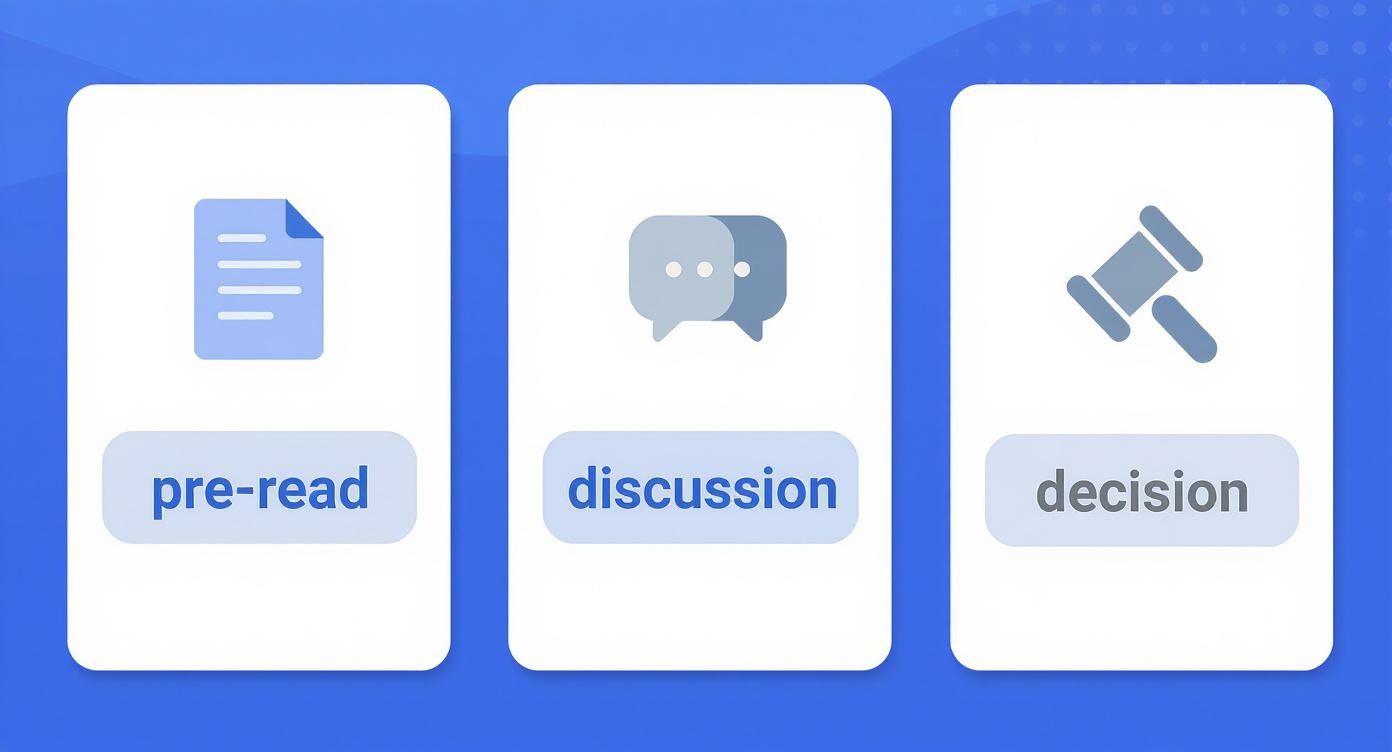
The key is the flow: start with pre-read materials to set the stage, carve out dedicated time for real strategic debate, and end with clear decisions that actually drive action.
# The Quarterly Business Review Agenda
The Quarterly Business Review (QBR) is all about performance, accountability, and making smart course corrections. You're here to assess last quarter's results and make tactical tweaks for the next one. This agenda perfectly balances a look back with a sharp focus on what's immediately ahead.
Here's a practical way to structure a QBR:
- (10 min) Call to Order & Consent Agenda: Knock out the routine stuff—like approving minutes and reports—fast.
- (20 min) CEO’s Performance Overview: A high-level story of the quarter's wins, losses, and key lessons. This isn't a data dump; it's a strategic narrative. Practical Tip: The CEO should frame this as a "What, So What, Now What" story to guide the discussion.
- (45 min) Deep Dive on Financials & Ops: Zero in on what’s different from the plan. Why did we miss or beat the forecast? What were the real drivers? This discussion should be guided by questions you sent out beforehand.
- (30 min) Strategic Initiative Update: A tight update on one or two top-priority projects. Are they on track? What roadblocks can the board help clear?
- (30 min) Forward Look Q&A: An open floor to pressure-test the plan for the upcoming quarter. The goal is to spot risks and opportunities, not to write a whole new strategy.
- (10 min) Closed Session & Adjournment: A private session for directors only to wrap things up.
This structure gets the board actively involved in refining the company's short-term execution instead of just passively reviewing data.
# The Annual Strategic Planning Session Agenda
Your annual strategy meeting is a completely different beast. It's entirely forward-looking, so you should spend almost no time on past performance. The whole point is to get everyone to lift their gaze to the horizon and set the company's long-term direction.
This meeting should feel more like a workshop than a presentation. The agenda must be designed to facilitate creative thinking and robust debate about the future, not to review the past.
Here’s a template built for that kind of long-term thinking:
- (15 min) Session Kick-off & Goal Setting: The Chair lays out the big strategic questions the board absolutely must answer over the next day or two.
- (60 min) External Environment Scan: A facilitated discussion on market trends, competitive shifts, and tech disruptions. This sets the scene. Practical Example: Use a PESTLE (Political, Economic, Social, Technological, Legal, Environmental) analysis framework to structure this discussion and ensure all external factors are considered.
- (90 min) Workshop: Long-Term Vision & Goals: Use breakout groups or a full-group workshop to debate and nail down the company's 3-5 year strategic pillars.
- (75 min) Debate on Major Strategic Initiatives: Now, focus on the big bets. What major investments—M&A, new markets, tech platforms—will it take to hit that long-term vision?
- (45 min) High-Level Resource Allocation: Talk about the capital and talent needed to fund those big bets. This isn't about detailed budgeting; it's about directional alignment.
- (30 min) Action Planning & Next Steps: Assign clear ownership for turning this strategic framework into an operational plan people can actually execute.
# The Urgent Special-Purpose Meeting Agenda
When a crisis hits or a massive, time-sensitive opportunity lands on your desk, you need an agenda that is ruthlessly efficient. There's no room for fluff—just the critical issue at hand.
This template is stripped down to the absolute essentials:
- (5 min) Call to Order & Statement of Purpose: The Chair clearly states the single reason for the meeting and the specific decision that needs to be made. Period. Example: "We are here today for the sole purpose of deciding whether to approve the term sheet for the acquisition of Company X."
- (30 min) Briefing on the Critical Issue: Management presents only the necessary facts, data, and analysis. It has to be concise and focused purely on informing the decision.
- (45 min) Deliberation & Scenario Analysis: A structured discussion of the options, risks, and potential outcomes. The Chair's job is to keep the conversation laser-focused.
- (10 min) Formal Motion & Vote: A clear motion is put on the table, debated briefly, and voted on.
- (5 min) Confirmation of Next Steps & Adjournment: Confirm who is responsible for executing the decision and what communications need to happen next.
While these templates cover very different situations, they all rely on the same principles: clear objectives and focused discussion. For a deeper dive, check out our guide on how to build a formal meeting agenda template (opens new window).
# Driving Accountability Before and After the Meeting
A perfectly crafted board meeting agenda is a great start, but it's only half the story. The real magic happens before anyone walks into the room and long after they’ve left. Without disciplined prep and solid follow-through, even the best agenda is just a piece of paper.
This all comes down to accountability, and that starts way before the meeting kicks off. The foundation is the board pack—that crucial collection of documents directors need to review. A sloppy or late board pack sabotages the meeting from the get-go, forcing directors to skim critical info on the fly instead of showing up ready to contribute.
# Preparing the Board Pack for Success
Here’s the golden rule: get the board pack out 5-7 days in advance. This isn't just a suggestion; it's a non-negotiable window that respects everyone's time and allows for real, thoughtful preparation. Sending it any later is a surefire way to get surface-level discussion.
But for a board pack to actually get read, it needs to be concise, insightful, and easy to scan. No one has time to dig through hundreds of pages of raw data.
Here's how to build a board pack that people will actually engage with:
- Lead with an Executive Summary: For any dense report (think financials or project updates), include a one-page summary. It should highlight the key takeaways, any deviations from the plan, and the critical issues that need attention.
- Ask Guiding Questions: Don't just dump information. Frame agenda items with specific questions you want directors to chew on, like, "Based on these numbers, what are the top two risks to our Q4 forecast?" This gets them thinking strategically before the meeting even starts.
- Keep It Lean: If a document is just for background and isn't tied to a specific decision, stick it in a separate "for information only" folder. This keeps the core pack tight and focused.
- Make It Visual: Use charts and graphs to make complex data easy to digest at a glance. A wall of text is an open invitation for people to start skimming.
Practical Tip: Create a standardized board pack template. This ensures consistency from meeting to meeting, making it easier for directors to find the information they need quickly. The template should define the structure for executive summaries and the preferred format for financial charts.
# Capturing Decisions and Driving Action
Once the meeting wraps up, the focus has to shift immediately to what happens next. The accountability loop only closes when you capture clear decisions and assign ownership to every single action item. This is where your meeting minutes become absolutely critical.
Minutes shouldn't be a word-for-word transcript. They need to be a sharp, focused record of what was decided and who is on the hook for the next steps. They’re a tool for action, not a historical archive. To make sure your post-meeting process is solid, it's worth reviewing an effective meeting minutes format that includes action items (opens new window) to tighten things up.
To make sure nothing ever falls through the cracks, supplement your minutes with a simple action log. Think of it as the single source of truth for all post-meeting tasks.
A simple, effective log can look just like this:
| Action Item | Owner | Due Date | Status |
|---|---|---|---|
| Draft a revised budget for the Q4 marketing campaign | Jane Smith | Oct 15 | In Progress |
| Secure legal review of the proposed vendor contract | David Chen | Oct 22 | Not Started |
| Schedule a follow-up session with the audit committee | Emily White | Oct 18 | Completed |
This simple table is what turns boardroom talk into real-world progress. By mastering both the pre-meeting prep and the post-meeting follow-up, you make sure your agenda actually does what it’s supposed to: move the organization forward.
Want to go deeper? Learn more about mastering post-meeting follow-through (opens new window) in our playbook.
# Using Technology to Your Advantage
In today's world of hybrid and remote work, technology can either be your best friend or your biggest headache during a board meeting. The goal is to make it disappear into the background, letting the conversation flow instead of causing friction. Getting this right goes way beyond just a video conferencing link; it’s about creating a secure, engaging, and seamless virtual boardroom.
A great place to start is with dedicated board portal software. Think of it as a digital command center. It centralizes everything—the board meeting agenda, pre-reading materials, minutes, and archives—all in one secure place. No more emailing sensitive documents around and wondering if everyone has the latest version.
These platforms also handle critical workflows. Instead of messy email chains, directors can use built-in tools for secure voting, e-signing documents, and even running performance reviews inside a compliant, self-contained environment. It just cleans everything up.
# Keeping People Engaged in Virtual Meetings
While a good portal solves the logistics, the human side of virtual meetings is a whole other beast. Staring at a screen for hours is draining. It’s tough to maintain the sharp focus needed for high-stakes decisions when you’re just a face in a box.
This is where smart agenda design and the right tools can make all the difference. A remote meeting needs a totally different rhythm.
- Go for Shorter Segments: Break down big topics into focused, 25-minute sprints. It works with natural attention spans and keeps fatigue from derailing the discussion.
- Build in Real Breaks: Schedule a mandatory 5-10 minute "cameras off" break every hour. Let people stand, stretch, and reset without feeling like they’re being watched.
- Make It Interactive: Plan specific moments for interaction. Use a quick poll for a gut check on a proposal or fire up a digital whiteboard to map out ideas visually.
Structuring your agenda this way keeps the energy up and ensures every director stays locked in.
# Nail Your Personal Tech Setup
Even with the best platform, nothing kills a presenter’s momentum faster than tech fumbles. We’ve all seen it: the awkward hunt for the mute, camera, or screen-share button. It’s a small thing, but it chips away at professionalism and distracts everyone.
This is where a simple, dedicated tool can be a game-changer.
Something like MuteDeck (opens new window) gives you a consistent, universal remote for all your meeting apps—Zoom, Teams, Google Meet, you name it. It pulls the most important controls out of the cluttered app interface and puts them right at your fingertips.
By pairing it with a physical device like an Elgato Stream Deck or even a foot pedal, you can manage your mic and camera without ever looking away from your notes or the other directors on screen. It’s a small tweak that removes all that friction, keeping the focus squarely on the conversation, not the software. While native controls exist, you can see why dedicated tools are a step up for serious users by exploring this MuteDeck vs. native meeting controls (opens new window) comparison.
Practical Tip: Make a "tech check-in" the very first item on any virtual meeting agenda. It takes two minutes for the facilitator to ask everyone to confirm their audio and video are working. This simple step prevents major disruptions once the real discussion kicks off.
Ultimately, the best technology is the technology you don't notice. By choosing a solid board portal and simple tools for personal control, you create an environment where the tech just works, letting the board focus entirely on what it's there to do: steer the organization forward.
# Got Questions About Your Agenda? We've Got Answers.
Even with the best templates, you're going to hit a few snags when building a board meeting agenda. It happens to everyone. Board members and administrators run into the same handful of tricky questions time and again.
Let's clear up the most common friction points with some straight-up, practical answers. Think of this as the "ask an expert" section to help you build your next agenda with confidence.
# Who Actually Owns the Agenda?
This one comes up a lot. While the Board Chair has the final say, creating the agenda should never be a solo mission. The best agendas are born from collaboration between the board and senior leadership.
Here’s how it usually plays out in the real world:
- The CEO and the Board Chair get together and hash out a first draft. They focus on the big, strategic rocks that absolutely need the board's attention.
- Then, the Corporate Secretary steps in to facilitate, looping in other directors and key execs to make sure no critical perspectives are missed.
Practical Tip: To facilitate input, the Corporate Secretary can circulate a "call for agenda items" email two weeks before the meeting. The email should ask for a brief description of the topic and, crucially, whether the item is for information, discussion, or decision. This streamlines the sorting process for the Chair and CEO.
# How Early Should the Agenda Go Out?
The gold standard is one full week (that's 5-7 business days) before the meeting. Send the final agenda and the complete board packet within this window.
Why a full week? It’s not an arbitrary deadline. It gives directors the breathing room they need to actually do their homework.
Anything less forces them to cram, which means you get surface-level comments instead of deep, strategic insights. For a really heavy topic—like a major acquisition or the annual budget—consider sending preliminary info even earlier. Let the details marinate so everyone shows up ready for a real conversation.
# What’s the Perfect Length for a Board Meeting?
There’s no magic number here. The real goal is impact over item count. A sharp, strategic agenda might only have five to seven core items. A bloated, report-heavy one could easily have a dozen or more. It all comes down to how you use the time.
For a typical three-to-four-hour meeting, I'd aim for six to eight substantive topics. This doesn't include the routine stuff you’ve already bundled into a consent agenda. This pacing gives you a solid 20-30 minutes for a meaningful discussion on each topic, which is enough time to dig into the issues that need the board's collective brainpower.
# How Do We Stop Our Meetings from Just Being a String of Reports?
This is probably the single biggest frustration I hear, but the good news is, it's totally fixable. If you want to shift your meetings from passive reporting to active problem-solving, you need to get disciplined.
Here are three tactics that work every time:
- Get Ruthless with Your Consent Agenda: This is your best friend. Any item that's routine, non-controversial, and doesn't need a debate belongs here. Think approving minutes or standard committee reports. Bundle them for a single, swift vote. No discussion necessary.
- Make Pre-Reading Mandatory: Establish a firm rule: all informational updates are delivered in the board pack, complete with a tight executive summary. The meeting room is not the place for someone to read their report out loud.
- Frame Agenda Items as Questions: This is a game-changer. Instead of an item like "Q3 Financials Review," rephrase it as "What Are the Key Risks and Opportunities in the Q3 Financials?" This simple tweak instantly shifts the conversation from a backward-looking summary to a forward-looking strategic debate.
Put these three practices into play, and you'll design an agenda that practically forces a focus on strategy. Your board meetings will become dramatically more valuable—and way more engaging.
A killer agenda is the first step, but a smooth meeting depends on seamless execution. To cut out the technical fumbling, MuteDeck gives you one-touch, universal control over your mic, camera, and screen sharing across any meeting platform. Stop hunting for buttons and start leading with confidence. You can try MuteDeck for free (opens new window) and feel the difference.